
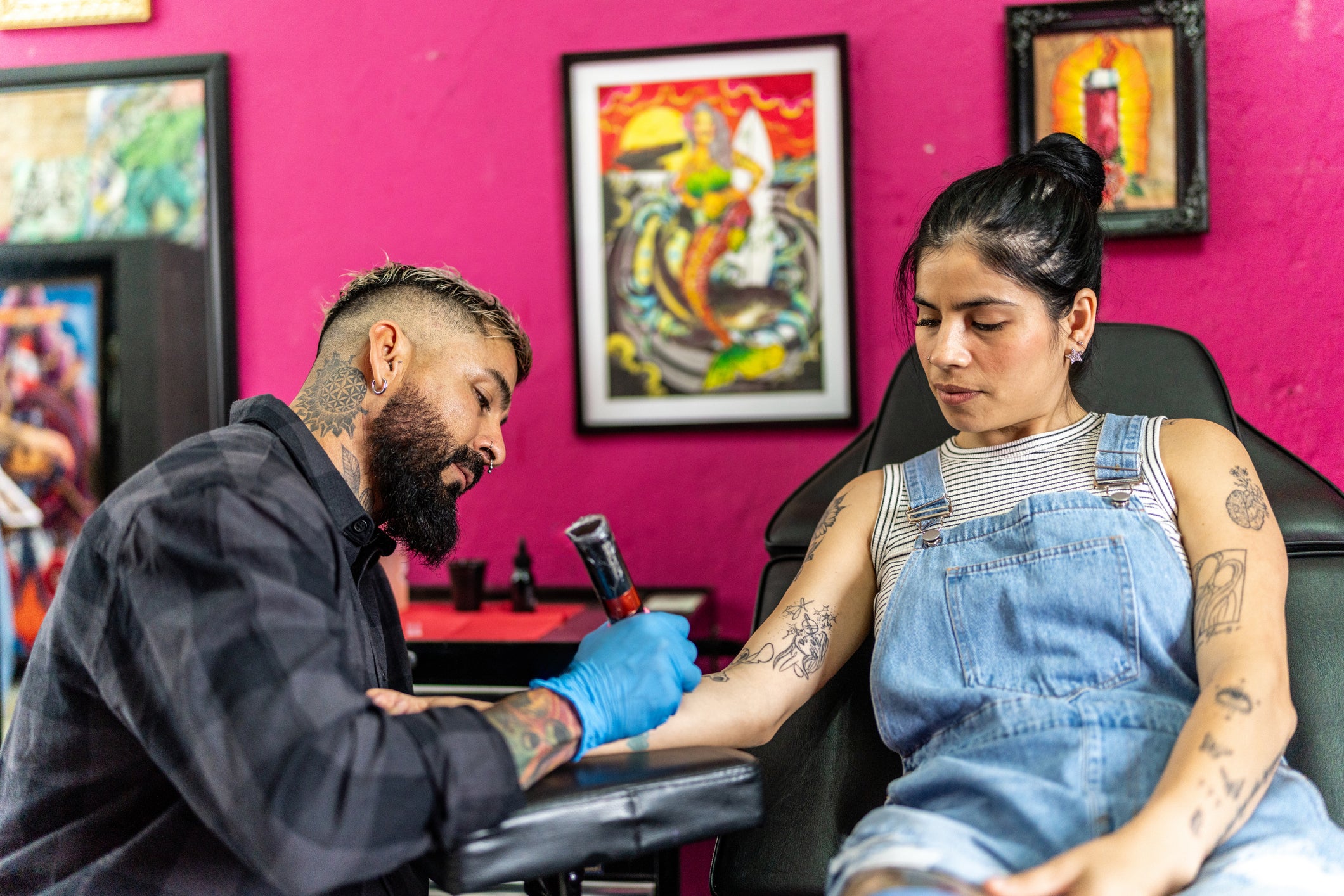
For those aspiring to become tattoo artists, the first question you'll likely face is "Where do I begin?" To become a tattoo artist, there are many things you need to learn, from preparing specialized tools to mastering basic techniques.
This article provides a detailed explanation of the essential tools for tattoo artists, effective practice methods, and how to set up a safe and hygienic working environment.

Tools to prepare for becoming a tattoo artist
To start working as a tattoo artist, it is essential to first acquire the appropriate tools. High-quality tool selection is crucial for professional work.
Here, we will explain in detail the essential basic tools that every tattoo artist should have, along with their roles and how to choose them.
How to choose a tattoo machine
A tattoo machine is one of the most important tools for a tattoo artist. Currently, the mainstream machines are divided into two types: rotary and coil (magnetic). Pen-style cartridge needle machines, which are becoming increasingly popular, are also classified as rotary type.
For beginners, a rotary tattoo machine is recommended due to its ease of use and low vibration. Rotary machines are versatile, capable of handling a wide range of tasks from outlining to shading.
Coil machines, on the other hand, are traditional tattoo machines excellent for powerful line work, but they require more practice to operate. When choosing a machine, weight balance, grip comfort, and ease of maintenance are also important criteria.

Types of power supply and how to choose them
The power supply is a crucial piece of equipment that provides stable power to the tattoo machine. The voltage adjustment function allows you to switch between appropriate power levels for lining and shading work.
Recently, wireless power supplies have become widespread, offering the advantage of eliminating the hassle of cords. The freedom provided by wireless equipment is a significant benefit, especially for long working hours or intricate tattoo positions.
Choosing high-quality clip cords and RCA cords also prevents poor connections and allows for stable tattooing. Select durable clip cords and RCA cords made from highly conductive materials.
Types of tattoo needles and how to choose them
It is important to select the appropriate type of tattoo needle depending on the task. Needles are primarily classified into lining and shading types, each with different characteristics.
Lining needles are designed with sharp tips to create fine lines, making them ideal for outlining. Cartridge needles are now mainstream, allowing for easy replacement and maintaining a hygienic working environment.
The thickness and arrangement of the needles change the texture of the lines and the intensity of the shadows that can be expressed, requiring an appropriate selection based on the artwork.
There are various types of tattoo needles, and it is necessary to use them according to their respective purposes. The table below summarizes the main types of needles and their characteristics.
| Needle Type | Primary Use | Characteristics |
|---|---|---|
| Round Liner (RL) | Outlining, fine lines | Circular needle arrangement, sharp line creation |
| Round Shader (RS) | Shading, blurring | Circular arrangement, soft expression |
| Magnum (MG) | Large area shading and packing | Two-row arrangement, efficient filling |
| Soft Edge Magnum (SEM) | Gradient expression | Curved shape, smooth finish |
Beginner Tattoo Artist Starting Set
For those aspiring to become tattoo artists, acquiring individual tools can be a burden both financially and in terms of knowledge. This is where a starting set, which includes all necessary tools, comes in handy.
Tools included in the set
A good starting set includes a tattoo machine, power supply, various needles, ink, and consumables. With these basic tools, you can start practicing immediately after purchase.
When checking the set contents, look at the quality of the tattoo machine, the functionality of the power supply, and the variety of needles. It is also important to confirm that sufficient quantities of consumables such as grips, tubes, and disinfectants are included.
Beyond the price, the quality of after-sales support is also a crucial factor in selection. Choosing a set that offers beginner-friendly instructions, video tutorials, and technical support will facilitate smoother learning.
The list of tools that should be included as a minimum in a beginner's starting set is as follows:
- 1-2 Tattoo machines (rotary type such as PEN machines)
- Power supply (or wireless type)
- Various needles (liners, shaders)
- Basic inks (black ink essential, several colors)
- Practice artificial skin (e.g., silicone skin)
- Transfer supplies (stencil paper, etc.)
- Basic hygiene supplies
FLAG Tattoo Supply's carefully selected tattooing sets


How to choose tattoo ink
Tattoo ink is a critical factor that determines the color development and longevity of a piece. High-quality ink provides vibrant colors and long-lasting results, while also ensuring safety.
When choosing ink, it is important to select products that are FDA-approved or conform to European standards. Reputable global ink brands generally meet these standards. It is important to choose brands that prioritize safety. Additionally,
If you're a beginner, it's recommended to start with basic black ink and gradually add color inks as your skills improve. A set of black inks with different concentrations for lining and shading is also recommended.
Sanitation supplies you should have
For a tattoo artist, hygiene management is one of the most important responsibilities, on par with or even exceeding technical skills. Proper hygiene not only protects the client's health but also directly ensures the artist's own safety.
Here, we will explain in detail the basics of hygiene management that professional tattoo artists must always adhere to.
Practice methods for beginner tattoo artists
Once you have your tools ready, the next step is to begin practicing to acquire actual techniques. Becoming a tattoo artist is not something that happens overnight, but requires gradual and continuous practice.
Here, we will explain in detail effective practice methods for beginners to acquire skills efficiently and how to proceed with them.
Training with practice materials
Before performing on actual skin, thorough foundational practice with practice materials is essential. Use artificial practice skin (such as silicone skin) to learn how to handle the machine and move the needle.
First, start by practicing basic lines like straight and curved lines on artificial skin, aiming to draw uniform lines at a consistent depth and speed, which forms the basis for all techniques. Next, challenge yourself with geometric patterns like circles and squares to improve your wrist and fingertip control.
Stencil creation techniques
Stencil creation is a critical skill for achieving accurate and beautiful tattoos. Mastering the technique of transferring hand-drawn designs onto stencil paper and accurately positioning them on the skin significantly improves the precision of the tattoo process.
In stencil creation, first, adjust the line thickness and density of the design appropriately to ensure it appears clear during transfer. Learn various techniques, from traditional methods using tracing paper and carbon paper to modern thermal printers.
Phased skill improvement program
For a tattoo artist, a planned and gradual approach is the most effective way to improve skills. By creating a systematic learning plan, from acquiring basic techniques to developing advanced ones, you can steadily enhance your abilities.
It is crucial to set specific goals for each stage and regularly evaluate your own work. Additionally, actively seek feedback from experienced artists to gain an objective perspective on skill improvement.
We recommend the following phased program for skill acquisition:
- Basic line practice (straight lines, curves, circles) - 1-2 months
- Mastering geometric patterns (triangles, squares, composite figures) - 2-3 months
- Shading fundamentals (gradients, blurring) - 3-4 months
- Completing simple designs (text, simple drawings) - 4-6 months
- Challenging complex designs (realistic expression) - 6 months onwards
Safety and hygiene management required of tattoo artists
For a tattoo artist, understanding and practicing safety and hygiene management are as important, if not more important, than technical skills. Proper hygiene not only protects the client's health but also directly ensures the artist's own safety.
Here, we will explain in detail the basics of hygiene management that professional tattoo artists must always adhere to.
Prevention of bloodborne infections
As contact with blood is unavoidable during tattooing, preventing bloodborne infections is paramount. To mitigate the risks of infections such as HIV, Hepatitis B, and Hepatitis C, strict adherence to standard precautions is necessary.
Handwashing and hand sanitization should be performed not only before and after procedures but also as needed during work. Disposable gloves must be changed for each task, and hands must be washed thoroughly after removing gloves.
Used needles and other sharps must be immediately disposed of in a dedicated puncture-resistant container and never reused.
Sterilization methods for instruments
For reusable instruments such as metal grips, proper sterilization is key to infection prevention. Sterilization using an autoclave (high-pressure steam sterilizer) is the most reliable method and meets medical standards.
The sterilization process consists of three stages: pre-cleaning, sterilization, and sterile storage. It is also important to use sterilization indicators to confirm that the sterilization process has been performed correctly.
Maintaining a clean working environment
A clean and organized working environment is a prerequisite for safe procedures. It is necessary to regularly disinfect all surfaces, such as workbenches, chairs, and lighting fixtures, to maintain cleanliness.
The treatment area must be clearly separated from other activity areas and not used for any purposes other than tattooing. Use waterproof barrier covers on work surfaces and change them for each client.

Building a Career as a Professional Tattoo Artist
After acquiring basic techniques and mastering safety management, it becomes crucial to work on building a career as a professional tattoo artist. Continuous technical improvement and expansion of specialized knowledge will allow you to grow into a competitive artist.
Here, we will explain concrete methods for career development and the path to acquiring specialized skills.
Practical experience in a studio
Practical experience in an actual tattoo studio is the most crucial learning opportunity for connecting theory and practice. By working as an apprentice or assistant in a studio, you can acquire practical skills in a professional environment.
Through practical work in a studio, you can also acquire important skills beyond technique, such as customer service, counseling, and design proposals. By gaining experience responding to various client requests under the guidance of experienced artists, you can develop flexibility and adaptability.
Portfolio creation and management
A professional portfolio is an essential tool for showcasing a tattoo artist's skill level and individuality. High-quality photographs of your work and a diverse range of styles will allow you to make a convincing appeal to clients and employers.
When creating a portfolio, it is necessary to accurately represent the details and color beauty of your work through appropriate lighting and angles. Preparing both digital and print versions of your portfolio, and utilizing social media and websites for online promotion, are also indispensable in today's world.
| Skill Acquisition Stage | Estimated Duration | Key Skills |
|---|---|---|
| Basic Practice Period | 3-6 months | Lining techniques, drawing basic shapes |
| Applied Techniques Period | 6-12 months | Shading, gradients |
| Practical Acquisition Period | 12-24 months | Color work, complex designs |
Summary
While the path to becoming a tattoo artist is certainly not easy, with the right tools and gradual skill acquisition, you can steadily progress towards becoming a professional.
To take your first step as a tattoo artist, start by choosing the appropriate starter kit and beginning basic practice.