
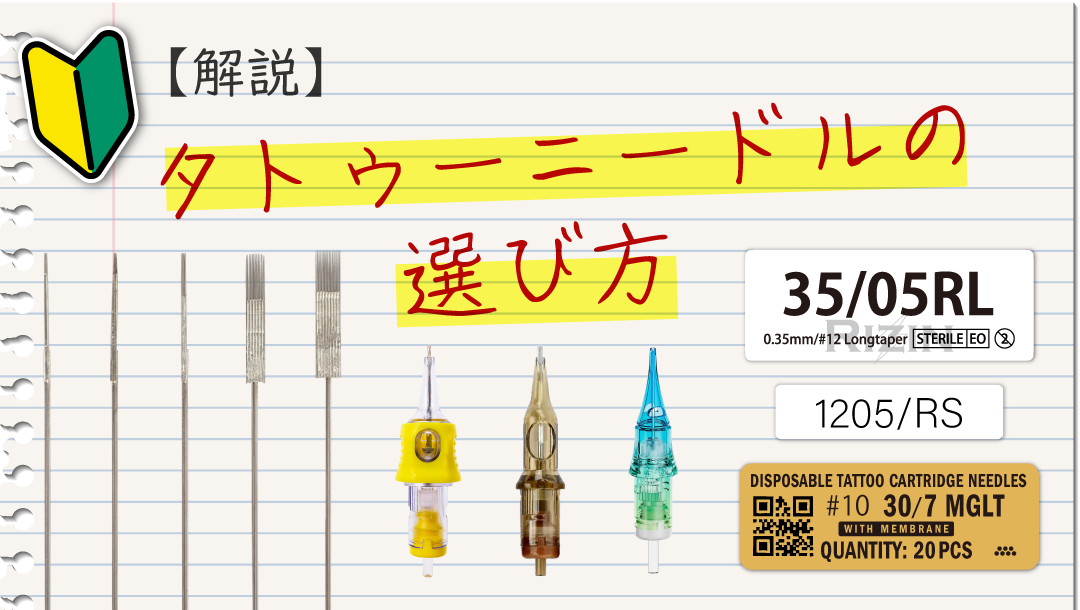
Although the notation methods and order of tattoo needle sizes and types, such as "35/05RL", "1205/RS", and "30/07MGLT", vary by manufacturer, the principle content is the same. The content of the notation is also the same for cartridge needles and classic needles with a bar.
Once you learn it, it's not difficult. In this article, we will explain the notation and basic uses of tattoo needles with illustrations.

The basic notation for tattoo needles is <Gauge> / <Count> <Configuration>
Tattoo needles are constructed by assembling individual loose needles into various counts and configurations, then soldering them to a bar.
Notations like "35/05RL" indicate the gauge of each individual needle, the number of needles assembled, the assembled configuration, and the taper of each individual needle.
Needle Gauge and Count
Although there are differences in "mm (millimeter) notation" and "gauge" notation, generally, the first two digits indicate the gauge of each individual needle (the red 〇 part in the image below). Although not listed here, there are also needles smaller than 0.25mm and thicker than 0.40mm.
08 gauge = 0.25mm(25)
10 gauge = 0.30mm(30)
12 gauge = 0.35mm(35)
14 gauge = 0.40mm(40)
The number following the gauge indicates the "count" (the green 〇 part in the image below). Thus,
"35/05" is composed of "gauge 12 = 0.35mm(35) needles / count 5 needles",
and "30/07" is composed of "gauge 10 = 0.30mm(30) needles / count 7 needles".

Needle Configuration
The letters following the gauge and count indicate the assembled needle configuration (the blue 〇 part in the image below).

4 Basic Types of Tattoo Needle Configurations
While diverse configurations exist, the four basic types are "RL", "RS", "MG", and "SEM".
RL: Round Liner
Needles are bundled in a circle and tapered to a fine point. Used for tattooing lines, fine details, and dots.
RS: Round Shader
Unlike RL, the needles are bundled in a circle but not tapered, remaining spread out. Used for tattooing shading and blending in small areas, or thick lines.

MG: Magnum
Also known as: M1 (Magnum1). Needles are arranged in two staggered rows. Used for shading, blending, and color packing/filling.
SEM: Soft Edge Magnum
Also known as: RM (Round Magnum), CM (Curved Magnum). The edges of the MG needles are rounded and softened. Used for seamless shading and blending.

Many Other Configurations
FL: Flat
Needles arranged in a flat configuration.
SS: Smooth Shader
Needles arranged flat with gaps. Only one row of MG.
M2: Magnum 2 (also known as Stack Magnum)
MG needles tightly packed without gaps.
ERL: Empty Round Liner
Also known as: Hollow Point Liner
RL configuration with the central core needle removed.

Needle Taper
Some manufacturers indicate the taper of each individual needle (the pink ○ part in the image below). There are notations such as LT: Long Taper, MT: Medium Taper, ST: Short Taper, but there are no standard specifications for what constitutes long or short in mm; these are merely relative indications from the manufacturer.

When a rod-shaped metal is sharpened into a needle, some needles are intentionally finished with an uneven, textured surface, creating countless fine grains. These are called "Textured" or "Unpolished" needles.
The advantage is that more ink adheres to the textured surface compared to smooth needles, allowing more ink to be delivered to the skin. However, the disadvantage is that it causes greater skin damage.
Extreme?! Monster Class!!
There are also what could be called extreme, monster-class needles, such as the "12123 Magnum" consisting of 123 needles, the "88 Domed Edge Round Shader" with 88 needles arranged like a dome, the "Plum Blossom 18 Round Shader" resembling a plum blossom, and the "5x3 RL Magnum" with 5 03RL needles arranged in a row. Ink Claw also manufactures and sells exciting tattoo needles that appeal to artists.


Video
The video below also provides an overview of tattoo needle basics.
Conclusion
We have explained the basics of choosing tattoo needles.
From using RL for liners to create shading, to using MG for line tattooing, the techniques are boundless depending on the artist's ideas. Master the basics and unleash your diverse techniques!
Writer:

-Middle-aged person who loves tattoos-
I recently got a new tattoo after 10 years. It was on the inner side of my upper arm, close to my armpit. With my old knowledge, I was very nervous about the pain, but it was far less painful than I imagined. This must be a testament to the skill of the tattoo artist and the evolution of equipment.